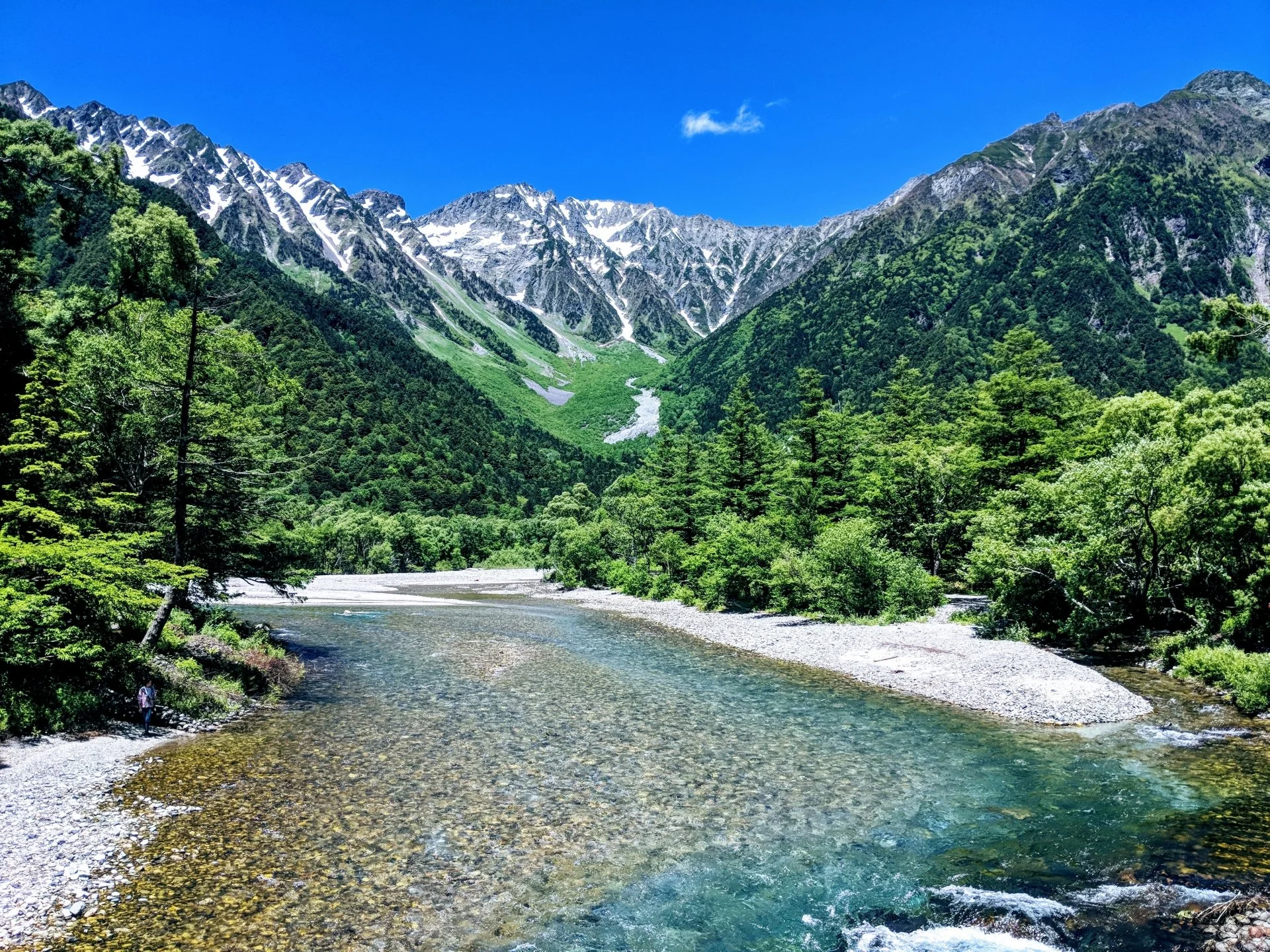
Kamikochi sits at about 1,500 metres in the Northern Japan Alps: a flat green valley threaded by the crystal-clear Azusa River and closed in on every side by the jagged Hotaka peaks. It looks like serious mountain country, and in every direction it is.
It also walks like a park. The main trails are flat boardwalk and gravel, you need no climbing gear at all, and the whole valley sits about ninety minutes from Takayama. That combination is what makes it one of the easiest great days out you can have from our town.
- Journey
- 1 hr 30from Takayama
- Season
- Apr 17 – Nov 152026
- Private cars
- Not allowedpark at Akandana
- Booking
- Not neededfirst come, first served
No cars, all year
Private vehicles are banned from the Kamikochi access road with no exceptions. Everyone arrives the same way: by bus or taxi from a designated car park. The two routes below are simply about where you leave your car, or whether you bring one at all.

01 / Getting thereTwo buses, one change
If you are staying in central Takayama, the public bus is the simplest way to go. No reservation is needed for either leg, and the ride itself is part of the day.
- Takayama Nohi Bus CenterTen to fifteen minutes on foot from the Old Town (Sanmachi).
Start here - Hirayu Bus TerminalNohi Bus, climbing through the Abo Tunnel beneath the Hida Mountains and crossing from Gifu into Nagano Prefecture.
60 min · change here - Kamikochi Bus TerminalShuttle bus down the steep curves of the Kama Tunnel, which delivers you straight into the valley.
30 min · you have arrived
02 / DrivingPark at Akandana, ride the shuttle
If you would rather have your own car for the rest of the day, drive as far as Akandana and take the shuttle from there. The driving part is easy: one road, most of the way.
- Takayama city centreTake National Route 158 towards Matsumoto.
Start here - Akandana Car Park850 spaces, and rarely full on a weekday morning.
60 min drive · ¥600 per day - Kamikochi Bus TerminalShuttle buses leave roughly every 30 minutes through the season.
30 min · ¥2,800 return
Local tip
Buy the shuttle ticket from the vending machine at Akandana before you queue. A return ticket also lets you break the journey at the Taisho-ike stop on the way back, which turns the longest walk in this guide into a one-way one.
03 / TimingWhen to go, and when not to
Kamikochi is beloved by Japanese travellers as much as foreign ones, and the difference between a weekday and a Sunday is not subtle. On a quiet Tuesday the boardwalk belongs to you and the birds. On a holiday weekend you queue for the shuttle, share every viewpoint, and may find Akandana full before you arrive.
If your dates are flexible, aim for a weekday, the week straight after a holiday period, or the quiet shoulders of the season in late April and early November, when the crowds thin out and the light is at its best.
Timing the day
Buses run roughly every 30 minutes, so a missed one costs you half an hour. Start early on peak weekends, and check the last shuttle before you set off: it leaves around 17:00 to 18:00 depending on the season.
04 / TrailsPick the walk that fits your day
Kamikochi's trails are almost entirely flat, a mix of wooden boardwalk and well-kept gravel path, and none of them need special equipment. Choose by the time and energy you actually have, not the one that sounds most impressive: the valley rewards a slow walk more than a fast one.
| Route | Time | Level | Best for |
|---|---|---|---|
| Classic loop | 1 hr | Easy | First visit, families, mostly paved |
| Myojin Pond | 2 hr | Easy | Old-growth forest, birdwatching |
| Wetlands loop | 3 hr | Moderate | Autumn colour, wide mountain views |
| Taisho-ike | 4 hr | Moderate | The full Nature Study Trail, best in spring |
| Tokusawa | 5 hr | Long day | June wildflowers, the quietest corners |
1 hour · Quick loop around the classics
The short version, and still a genuinely good walk. Cross Kappa Bridge for the classic Hotaka panorama, then follow the Azusa River back down the other bank. Pause at the Weston Relief, a monument to Walter Weston, the British missionary who taught Japan to climb its own mountains for pleasure.
2 hours · Myojin Pond, a sacred detour
Walk out along the left bank through old-growth forest, then come back on the right bank where the valley opens up to the river. Myojin Pond sits within the inner grounds of Hotaka Shrine, and the ¥500 admission buys you the quietest twenty minutes of the day.
3 hours · Myojin and the wetlands loop
After the stillness of Myojin, turn west towards Tashiro Bridge and Nakanose Garden. In autumn this stretch is the best colour in the valley, and the view of the Hotaka Range across Tashiro Wetland is the one that tends to stay with people.
4 hours · All the way to Taisho-ike
The valley's most complete day, covering the Nature Study Trail from end to end. The forest section winds through moss-covered old growth where the light comes down in shafts, and Taisho-ike is about an hour beyond Kappa Bridge. Catch the shuttle home from the Taisho-ike stop rather than walking back.
5 hours · Deep valley, all the way to Tokusawa
This is the route for the valley's quietest corners. In early June the meadows at Tokusawa are covered in white Nikko anemones and the forest is loud with birds: listen for the Japanese bush warbler and, if you are lucky, the Siberian blue robin. It makes for a long day, so bring rain gear and more water than you think you need.
Add an hour to every estimate
These times cover walking only, with no stops for photographs, wildlife or lunch. In practice most people take 30 to 60 minutes longer, and the last shuttle does not wait.
You do not need to climb a single metre of the Hotaka Range to be stopped by it.
On the walk to Taisho-ike
05 / HighlightsWhat everyone comes to see
Kappa Bridge
The valley's postcard: a wooden suspension bridge over clear water, with the Hotaka Range standing directly behind it. Almost everyone starts and ends here, and almost everyone crosses it twice.
Taisho-ike Pond
Formed when Mt. Yakedake erupted in 1915 and dammed the river, the pond holds a mirror to the volcano that made it. Bare, bleached trees still stand in the shallows, which is either haunting or beautiful depending on the light, and usually both.
Myojin Pond
Tucked inside the inner grounds of Hotaka Shrine, the water here is so clear you can watch char hanging motionless above the stones. It was once known as the Mirror Pond, and on a still morning the name explains itself.
06 / PracticalitiesWhat to wear, what to bring
No climbing gear, but do remember where you are. At 1,500 metres the temperature drops sharply once the sun goes behind a ridge, spring and autumn mornings are properly cold, and the UV is stronger than it feels.
Clothing
- Windproof outer layer. Essential in spring and autumn.
- Layers you can add and shed as the valley warms through the morning.
- A hat for the altitude sun.
- Comfortable trainers or hiking shoes. Boots are welcome but not required.
Kit
- A backpack, so your hands stay free on the boardwalks.
- A rain jacket rather than an umbrella, which is awkward on narrow trails.
- Water. Buy drinks near Kappa Bridge before you set off, as there is nothing along the trails.
- Sunscreen.
07 / Eat and unwindThree stops worth planning around
Sanzoku curry spaghetti
A generous plate of curry spaghetti under crisp sanzoku-yaki fried chicken, eaten with the Hotaka peaks in the window. Udon, soba and plain curry are on the menu too, and portions are built for people who have been walking.
Rare cheesecake
Kamikochi's most famous sweet: rich but not heavy, served with blueberry jam in a calm wood-panelled room beside Kappa Bridge. The Shinshu apple pie has just as many devotees.
Natural hot spring bath
Free-flowing natural onsen with indoor and outdoor baths and famously soft water, which is exactly what tired legs are asking for. Day visitors are welcome from 11:00 to 13:00, with last entry at 12:30, so this one needs planning into the morning rather than the end of the day.
The guides who walk it every week
A local nature guide knows which bend in the river the monkeys favour this week, which stand of trees is turning first, and which viewpoint empties out at the exact hour everyone else is queuing for the shuttle.
Go deeper with a nature guide
The best of Kamikochi is not marked on the tourist map. Because your guide drives, the bus timetable stops deciding how your day goes.
- Quiet spots that buses simply do not reach
- Plants, animals and geology explained as you walk
- Your own schedule, with no queuing
- Seasonal knowledge: what is at its best, this week
08 / Good to knowBefore you set off
- Crowds. Weekends are busy and holiday weekends are very busy. Golden Week, Obon and the autumn foliage weekends are the peaks of the year.
- Buses. No reservation for the Takayama–Hirayu bus or the Akandana shuttle. All seats are first come, first served, roughly every 30 minutes.
- Season dates. The 2026 season runs from Friday 17 April to Sunday 15 November. Outside those dates the valley is closed to visitors.
- Cars. Private vehicles are banned from the access road all year round. Park at Akandana on the Gifu side or Sawando on the Nagano side.
- Children. Under-1s travel free. From age one, every child needs their own seat and ticket on Kamikochi-line buses.
Useful contacts
- Nohi Bus, Takayama office. 0577-33-7780
- Nohi Bus timetables. www.nouhibus.co.jp
- Kamikochi official site. www.kamikochi.or.jp
- Guide enquiries. Send us a message